
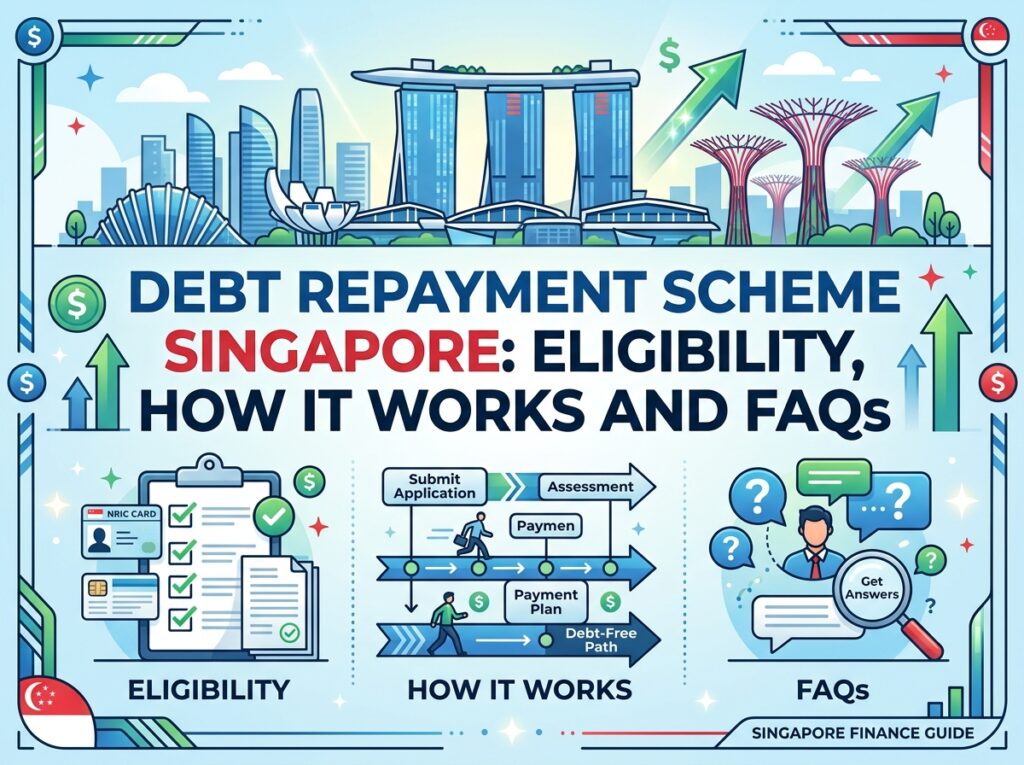
If you are struggling to repay your debts in Singapore, you may have come across the Debt Repayment Scheme (DRS). It is a government-administered scheme designed to help eligible debtors repay their debts through an approved repayment plan instead of being made bankrupt.
However, one important detail is often misunderstood: you cannot apply directly for DRS simply because you are having difficulty paying your debts. The scheme is considered in connection with bankruptcy proceedings, and being referred for assessment does not guarantee acceptance.
Understanding how DRS works, who may qualify and what happens if you are not eligible can help you make a more informed decision about your financial situation.
In this guide, we explain the key DRS requirements in Singapore, how the assessment process works, what repayment involves and what other options you may wish to explore.
What Is the Debt Repayment Scheme (DRS) in Singapore?
The Debt Repayment Scheme (DRS) is administered by the Official Assignee under Singapore’s Ministry of Law. It allows eligible debtors who are involved in bankruptcy proceedings to repay their debts through an approved Debt Repayment Plan (DRP) instead of being made bankrupt.
Under the scheme, the debtor must comply with the approved repayment terms, including making the required monthly instalments and paying applicable statutory fees. A repayment plan can run for a maximum of five years.
Once the debtor successfully completes the plan, they are released from the debts admitted under DRS, subject to the applicable rules.
The scheme is intended to provide a structured repayment route for people who meet its requirements. However, it is not available to everyone experiencing financial difficulty.
For the official explanation, refer to the Ministry of Law’s Debt Repayment Scheme guide.
Who Is Eligible for DRS in Singapore?
To be considered for DRS, a debtor must meet the eligibility criteria set out by the Ministry of Law.
The main requirements include:
- Total liabilities must not exceed S$150,000.
- The debtor must be gainfully employed and earning a regular income.
- The debtor must not have been bankrupt or placed on DRS within the preceding five years.
- The debtor must not have been subject to a court-based arrangement within the preceding five years.
- The debtor must not be a sole proprietor or a partner in a firm.
These are important initial requirements. If a person does not meet any of the stated eligibility criteria, they will be considered ineligible under the scheme.
Meeting these requirements alone does not mean that DRS will be approved. The process also involves a referral through the Court and an assessment by the Official Assignee.
Because eligibility depends on specific rules and individual circumstances, it is best to check the latest official requirements rather than rely solely on general information found online.
You can read the full criteria in the Ministry of Law’s Information for Debtors guide.
Can You Apply for DRS Directly?
No. An individual cannot directly sign up for DRS through a private debt consultancy or by submitting a standalone application to the Official Assignee.
DRS is initiated in connection with a bankruptcy application filed in the High Court, either by the debtor or by a creditor.
The Court may refer the case to the Official Assignee for an assessment if the applicable requirements are met, including the total-liabilities threshold. The Official Assignee then determines whether the debtor is suitable for the scheme.
This distinction matters because there is a difference between understanding whether DRS might be relevant to your circumstances and actually being eligible to enter the scheme.
A debt consultant may help you understand your financial position and discuss available options. However, a private consultancy cannot guarantee that the Court will refer your case or that the Official Assignee will approve you for DRS.
How Does the DRS Process Work?
The process involves several stages, and it is important to understand that referral does not mean acceptance.
1. A bankruptcy application is filed
A bankruptcy application must first be filed in the High Court. It may be filed by the debtor or a creditor.
DRS is therefore not a general debt restructuring programme that anyone can join simply by requesting assistance.
2. The Court considers whether to refer the case
The Court may refer the case to the Official Assignee for a DRS assessment if the relevant requirements are met.
The referral allows the Official Assignee to consider the debtor’s eligibility and suitability. It does not mean that the debtor has already been accepted into the scheme.
3. The Official Assignee assesses the debtor’s circumstances
The debtor may need to provide financial information, including details of their liabilities, income, expenditure and supporting documents.
This information helps the Official Assignee assess the case and consider whether a repayment arrangement is suitable.
4. A repayment plan is considered
If the debtor is found suitable, a Debt Repayment Plan may be offered. The plan sets out the repayment obligations and other applicable terms.
The debtor must understand these obligations before proceeding because entering DRS requires ongoing compliance.
5. The debtor follows the approved plan
Once the plan commences, the debtor must make the required payments and fulfil their duties under the scheme.
If the debtor successfully completes the plan, they are released from debts admitted under DRS, subject to the applicable rules. Failure to comply can have serious consequences, including the possibility of further bankruptcy proceedings.
For more details, refer to the official DRS information for debtors.
How Much Do You Have to Repay Under DRS?
There is no single monthly instalment amount that applies to every DRS debtor.
The repayment amount and terms are determined through the assessment and approved Debt Repayment Plan. Debtors must comply with the payment obligations set out in their respective plans, together with applicable statutory fees.
It is therefore misleading to assume that everyone entering DRS will receive the same reduction in monthly payments or have a fixed percentage of their debt written off.
Before making financial decisions, consider your actual income, essential living expenses, existing liabilities and ability to maintain repayments over time.
A repayment arrangement should be understood in terms of what it requires from you, not just whether the monthly amount appears manageable at first.
Does DRS Write Off Your Debt?
DRS is primarily a structured debt repayment scheme, not an automatic debt cancellation programme.
Debtors placed on the scheme must fulfil their approved repayment obligations. Upon successful completion, they are released from debts admitted under DRS, subject to the applicable rules.
This is different from promising that all outstanding debts will immediately disappear or that a debtor will receive a particular discount.
If you are considering DRS, make sure you understand which debts are covered, the repayment terms and the consequences of failing to comply.
How Long Does DRS Last?
A Debt Repayment Plan under DRS can last for up to five years.
The actual repayment period depends on the plan offered and the debtor’s circumstances. It should not be assumed that every debtor will receive the same repayment duration.
It is also important to consider whether you can maintain the required instalments throughout the plan. Changes in employment, income or essential expenses may affect your ability to meet your obligations.
The Official Assignee expects debtors to fulfil their duties under the scheme, including providing updated information when required and complying with the approved repayment terms.
What Happens If You Do Not Qualify for DRS?
Not everyone experiencing debt problems will qualify for DRS. Some people may not meet the eligibility criteria, while others may be found unsuitable following assessment.
If a debtor is found unsuitable, the case may be referred back to the High Court, and the bankruptcy proceedings may resume.
This is why it is important not to assume that DRS will be available simply because your total liabilities are below S$150,000 or because you have a regular income.
If you do not qualify, it does not automatically mean that you have no other options. The next step is to understand your circumstances and consider what other forms of debt assistance may be relevant.
The appropriate approach depends on factors such as the types of debts you owe, your income, your financial commitments and the stage of any existing proceedings.
You can read more about the process on the Ministry of Law’s Pre-Bankruptcy information page.
What Happens If You Miss a DRS Payment?
Once a Debt Repayment Plan begins, debtors are expected to comply with its terms, including making the required instalments.
Missing a payment should not be treated as a minor issue or ignored. If you experience difficulty meeting your repayment obligations, contact your case administrator promptly and seek clarification on the appropriate steps to take.
The Official Assignee may issue a Certificate of Failure if the debtor does not comply with the plan or fulfil the required duties. Following this, creditors may commence fresh bankruptcy proceedings.
If your income or employment circumstances change, you should also inform your case administrator as required under the scheme.
The important point is to address difficulties early rather than assume that missed payments will have no consequences.
Is DRS the Only Debt Repayment Option in Singapore?
No. DRS is one of several debt-related arrangements available in Singapore, and it is designed for a particular situation involving bankruptcy proceedings.
Depending on your circumstances, other options may be worth exploring.
Debt Management Programme (DMP)
Credit Counselling Singapore offers a Debt Management Programme for eligible individuals who need assistance managing unsecured debts. The programme and its suitability requirements differ from DRS.
Visit Credit Counselling Singapore for information about its services.
Debt Consolidation Plan (DCP)
A Debt Consolidation Plan is offered by participating financial institutions to eligible borrowers who meet the relevant requirements. It is intended to consolidate qualifying unsecured debts into a repayment arrangement.
Eligibility and terms depend on the applicable requirements and the financial institution.
You can find more information through the Monetary Authority of Singapore and participating financial institutions.
Other repayment arrangements
Depending on your circumstances, it may also be appropriate to contact your creditors to understand what repayment arrangements they may consider.
The options available will depend on your debt profile, financial circumstances and the relevant parties’ requirements. Not every arrangement will be suitable for every person.
Rather than focusing on a single programme from the beginning, it is useful to understand your complete financial position and assess which options may realistically apply.
How Can You Avoid Misleading Debt Consultancy Claims?
When searching online for help with debt, you may encounter claims promising large debt reductions, guaranteed approval or a quick way to avoid bankruptcy.
It is important to approach such claims carefully.
DRS is administered by the Official Assignee and involves a formal process connected to bankruptcy proceedings. A private consultancy cannot independently place someone on DRS or guarantee that the authorities will approve a repayment plan.
Before engaging a debt consultancy, consider asking:
- What services does the consultancy actually provide?
- Will the consultation explain the available options, including what I can do myself?
- Are any fees clearly explained before I agree to a service?
- Are claims about debt reductions or approval supported by reliable information?
- Does the advice distinguish between government-administered schemes and private services?
The Ministry of Law has published information warning the public about misleading debt consultancy advertisements. You can read its official pre-bankruptcy guidance.
A reliable consultation should help you understand your situation and the limits of each option. It should not pressure you into making a decision based on promises that cannot be guaranteed.
Frequently Asked Questions About DRS in Singapore
1. Can I apply for DRS without being involved in bankruptcy proceedings?
No. DRS is initiated in connection with a bankruptcy application filed in the High Court. A person cannot apply directly to join the scheme simply because they are struggling with repayments.
2. What is the maximum debt allowed under DRS?
The stated eligibility threshold is total liabilities of no more than S$150,000. Other eligibility requirements must also be met, and the Official Assignee must assess suitability.
3. How long can a DRS repayment plan last?
A repayment plan can run for up to five years. The actual duration depends on the plan offered.
4. Will I automatically qualify if I have a regular income?
No. Regular income is one of the stated eligibility requirements, but it is not sufficient on its own. The other eligibility criteria and suitability assessment also apply.
5. What happens if I fail to comply with DRS?
Failure to comply with the repayment plan or other required duties may lead to a Certificate of Failure. Creditors may then commence fresh bankruptcy proceedings.
6. Can a debt consultancy guarantee DRS approval?
No private consultancy can guarantee an outcome controlled by the Court and the Official Assignee. Be cautious of claims that promise approval or guaranteed debt reductions.
7. What if I do not qualify for DRS?
You can explore other debt assistance and repayment arrangements that may be relevant to your circumstances. The appropriate options depend on your debts, income, financial commitments and current situation.
8. Where can I find the official DRS requirements?
The Ministry of Law provides official information on the scheme, eligibility criteria, debtor responsibilities and application process through its Debt Repayment Scheme website.
Understand Your Debt Situation Before Deciding What to Do Next
Finding out about DRS is a useful starting point, but it is only one part of understanding your debt situation.
Before deciding on your next step, consider how much you owe, who you owe, your monthly income, your essential expenses and whether you can realistically maintain your current repayments.
If DRS does not apply to your circumstances, other arrangements may be worth exploring. The important thing is to understand the available options before making a decision.
At EDUdebt, we provide debt consultations to help individuals understand their financial situation and review possible repayment options in Singapore.
A consultation can help you organise the information about your debts, understand the options that may be relevant to you and consider the next steps. It does not guarantee eligibility for any government scheme or a particular repayment outcome.
If you are unsure where to begin, you can arrange a free consultation with EDUdebt to discuss your situation and understand your options.
Visit www.edudebt.sg to find out more.
Important note: This article is intended for general educational purposes and is not legal or financial advice. DRS eligibility, procedures and other requirements are subject to the applicable laws and official guidance. Please refer to the Ministry of Law for the latest information and seek appropriate professional advice where necessary.
Official sources
Ministry of Law — About the Debt Repayment Scheme